 |
|
Etheldreda
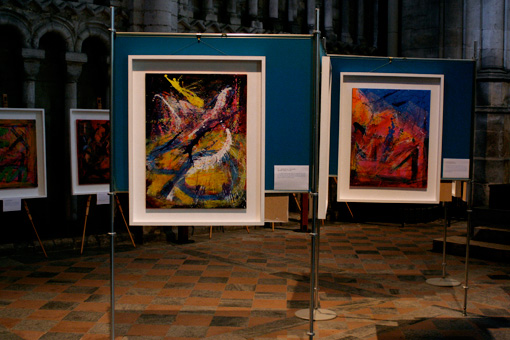
exhibition in the Lady Chapel, Ely Cathedral, June 2007
by Molly Dyson
Etheldreda has long been celebrated as an English saint and is commemorated in church dedications and religious art. The Round Church in Cambridge contains a stained glass window portraying the saint with traditional religious iconography. She is shown holding two lilies, symbols of her virginity and an open book as a symbol of her learning; whilst overhead the dove, symbol of the Holy Spirit, hovers.
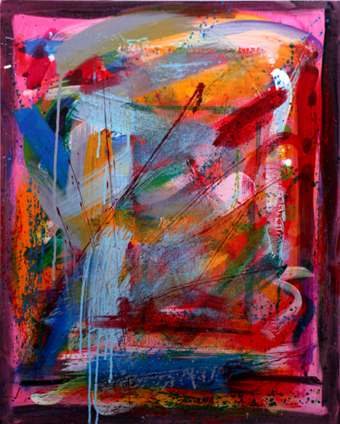
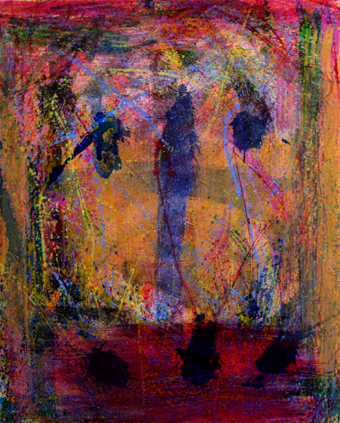
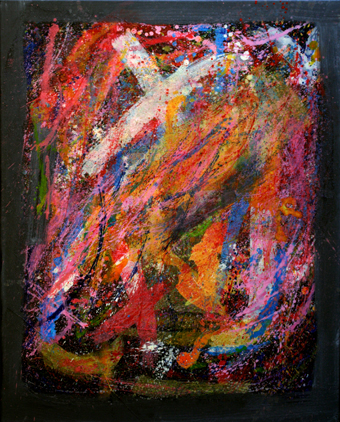
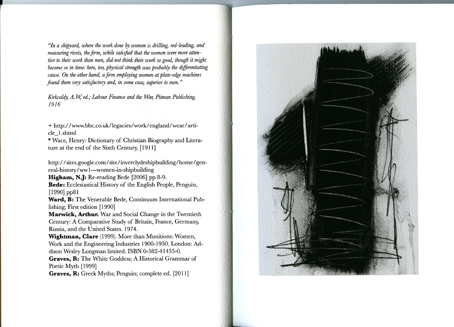
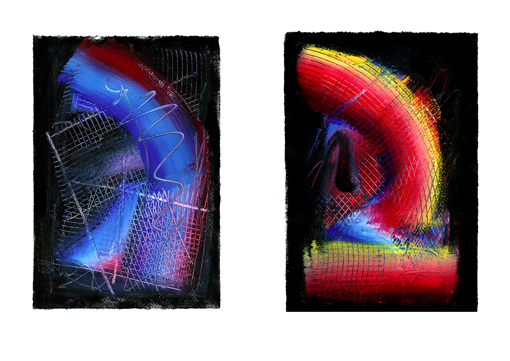
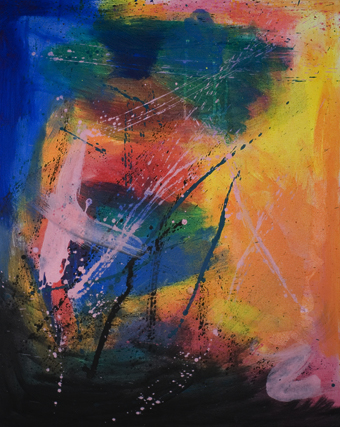
The viewer of this exhibition will, with a little gentle concentration, discover the themes and symbols of Etheldreda in Wellen’s work just as readily as in the traditional iconography of the past. The paintings and prints are joyous and bold and have an immediate appeal that is both sensuous and exciting.
Wellen is fascinated with storytelling and how stories are changed over time according to the viewpoint and purpose of the person relating the story.
Etheldreda’s story is related, in the first instance by the Venerable Bede, - shortly after her death. From him we have a picture of a strongly feminine character who resisted the consummation of two marriages because of her desire to live the life of a nun and to be in harmony with her Lord. This is a theme which finds echoes with the twentieth century feminist movement.
In her lifetime we see how Etheldreda was perceived differently by those around her. Her father and uncle viewed her as a valuable prize in making political alliances through marriage. Bishop Wilfred perhaps saw her as a friend and ally in his views which conflicted with those of Abbess Hilda at the Synod of Whitby. Whilst to Ovin, her steward, she was simply his ‘master’.
Over the years, different aspects of her story are emphasised. For instance in mediaeval times, the incorruptibility of her bodily remains became an important aspect. This, naturally, attracted pilgrims to her shrine and commercial profit to the cathedral and city.
So we have many layers to Etheldreda’s story, which has changed and shifted over the years since it was first recorded. Wellen’s paintings and prints are constructed of many layers, each one influencing what we see of the layer that lies beneath it.
When we think about Fenland in those distant times, it is easy to conjure up an image of a dark, wet and dangerous place, a place where sudden death, slow starvation and disease were common. Such places and their inhabitants were to be feared; perhaps even Satan himself lurked in those black waters. Into this grim, dark region Etheldreda arrives in the mid 670’s we are told by Bede, to found her religious house at Ely. She establishes an ordered community where the light of Christ shines like a beacon in the darkness of the surrounding fens.
The theme of darkness and light runs through the works in this exhibition. It is only with light that the human eye can perceive colour. Wellen’s colours are bold and vibrant, - yet superimposed on a darker ground.
Titles such as ‘Into the Light’ and ‘Lay aside Earthly Cares’ are direct borrowings from the words of Bede and they invite the viewer to add their own perceptions to what they are looking at in order to enrich their appreciation and understanding. Other images remain rather more obscure and less explicable in mere words; their appeal is very much to our visual sensibilities.
The paintings and prints have to, and do, speak for themselves in a most eloquent way.
Molly Dyson
|
|
|
|